


DCPA Monomer: The Perfect Balance of High Hardness and Low Shrinkage
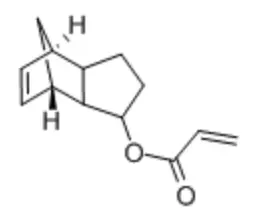
DCPA is an acrylate functional monomer characterized by a unique rigid bicyclic structure. Due to its molecular structure, it imparts numerous superior properties to materials after curing, playing an indispensable role in the field of high-performance radiation-curable materials.
I. Performance Characteristics
The performance of DCPA stems from its dicyclopentenyl rigid cyclic structure, which significantly differentiates it from common linear or monocyclic acrylate monomers.
1. Extremely High Crosslink Density & Hardness
DCPA is a monofunctional UV-curable monomer featuring a rigid bicyclic aliphatic backbone, providing high hardness and scratch resistance.
The hardness performance of this rigid bicyclic aliphatic skeleton typically far exceeds that of other monofunctional monomers.
2. Excellent Heat Resistance
The rigid bicyclic structure acts like a "skeleton" for the material, greatly restricting the thermal movement of molecular chains.
Consequently, coatings or materials prepared from it exhibit a high Glass Transition Temperature (Tg) and Heat Deflection Temperature (HDT), offering superior thermal stability.
3. Low Shrinkage
Volume shrinkage occurs during the curing process as liquid monomer transforms into solid polymer. DCPA's bulky rigid cyclic structure occupies a relatively large volume before reaction, resulting in smaller changes in intermolecular distance during curing.
This characteristic gives it a significantly lower volume shrinkage rate compared to other acrylate monomers. This is beneficial for improving adhesion to substrates (especially plastics and precision electronic components), reducing internal stress, and preventing product warpage.
4. Excellent Chemical Resistance
The highly crosslinked, dense network effectively blocks the penetration and erosion of various chemical solvents.
It exhibits outstanding resistance to chemicals such as acids, bases, alcohols, gasoline, etc.
5. High Reactivity
Despite its bulky molecular structure, its acrylate double bond retains high reactivity, enabling rapid curing under UV light or electron beams to meet the demands of high-speed industrial production.
6. Hydrophobicity
Its molecular structure possesses hydrophobic characteristics, imparting good water resistance and low water absorption to coatings.
II. Application Fields
Based on these outstanding properties, DCPA is widely applied in fields with demanding performance requirements.
1. High-Performance UV-Curable Coatings
Plastic Coatings: Used for high-end plastic casings (e.g., mobile phones, laptops, automotive interior parts) to provide excellent feel with high hardness, scratch resistance, and anti-fingerprint properties.
Metal Coatings: Used as primer or topcoat for printing and protection on metal cans, bottle caps, offering excellent adhesion and chemical resistance (e.g., resistance to content corrosion).
Wood & Floor Coatings: Used to manufacture UV floor lacquers with high hardness, wear resistance, and scratch resistance.
2. Electronic Chemicals & Photoresists
Printed Circuit Boards (PCBs): Used as a key resin monomer in solder mask inks, leveraging its high heat resistance (to withstand soldering temperatures), high hardness, excellent electrical insulation, and chemical corrosion resistance (against etching and plating solutions).
Photoresists: Can be used as a component in photoresists for semiconductors or liquid crystal displays requiring high heat resistance, low shrinkage, and excellent resolution.
3. 3D Printing & Additive Manufacturing
In photopolymerization 3D printing (e.g., SLA, DLP), DCPA is a crucial raw material for formulating high-performance resins.
It effectively reduces shrinkage and warpage of printed models, improves dimensional accuracy, and imparts high heat resistance and strength to printed objects. It is particularly suitable for manufacturing engineering plastic prototypes, high-temperature jigs, etc.
4. Adhesives
Used to formulate high-performance UV-curable adhesives, especially in bonding applications requiring fast curing, high cohesive strength, and heat resistance.
III. Product Advantages Summary
Compared to traditional monomers, the core advantages of DCPA can be summarized as:
"Strong": Imparts very high hardness and mechanical strength to materials.
"Stable": Provides outstanding heat resistance and dimensional stability (low shrinkage).
"Resistant": Possesses exceptional chemical and solvent resistance.
"Specialized": A specialty monomer designed specifically for high-performance, demanding application environments.
In summary, DCPA is a premium functional monomer engineered to enhance the ultimate performance of materials. It is one of the preferred raw materials for radiation-curable products requiring high hardness, high heat resistance, and low shrinkage.